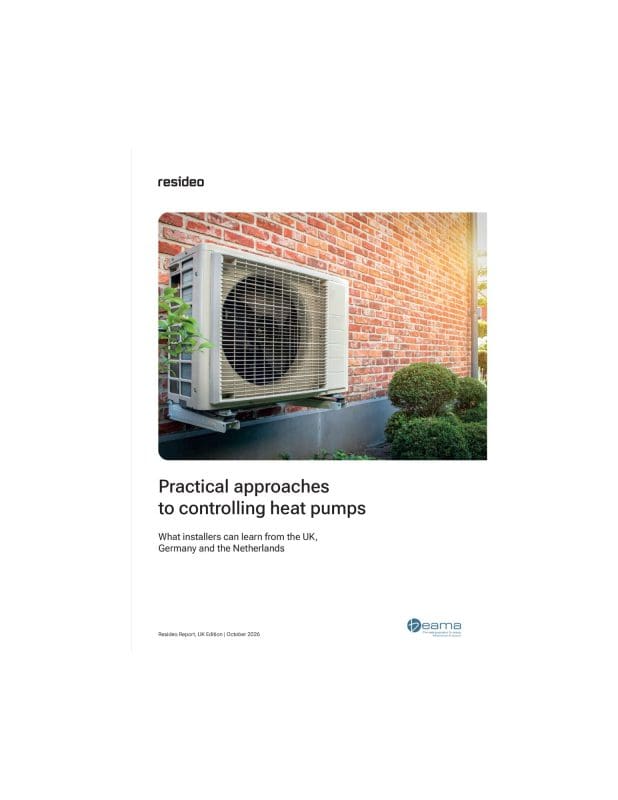
As part of its National Heat Pump Week activity, Resideo has expanded its heat pump control report – Practical approaches to controlling heat pumps – with new technical guidance on configuring thermostats to balance responsive room-temperature control with the operating requirements of the connected heat pump.
The new content addresses an area of active industry debate. There is no single control or hydraulic arrangement that is right for every heat pump installation. The appropriate approach depends on the appliance, system volume, modulation range, building characteristics and the way the home is used. What remains important is that controls support comfortable room temperatures without creating unnecessarily short operating periods or rapid restarts.
To help installers navigate these considerations, the update to the report explores how heat-pump-specific controls can be configured around three key operating parameters:
- Maximum cycles per hour
- Minimum on time
- Minimum off time
The guidance explains how these settings can be configured in line with the heat pump manufacturer’s requirements. The maximum cycles-per-hour setting is a limit rather than a target, and a new heating cycle is initiated only when demand is sufficient to meet the configured minimum on-time requirement. This gives installers a practical framework for configuring room-temperature control around common heat pump operating characteristics rather than applying conventional boiler-control settings.
Ian Little, Resideo’s UK Business Development Manager and Heat Pump Association representative, said: “Controls for heat pumps cannot simply follow the operating assumptions commonly used for boilers. This guidance gives installers a framework for configuring room-temperature control around the heat pump manufacturer’s requirements, hydraulic design and the needs of the property. The aim is to support responsive room comfort without encouraging short operating periods or rapid restarts.”
Thermostat configuration is only one part of system design. Minimum flow, system volume, hydraulic configuration, weather compensation and the heat pump manufacturer’s control strategy must also be considered to support stable operation.
The heat-pump-optimised control sequence can be summarised in five stages:
- Monitoring room temperature against the target setpoint.
- Configuring the maximum cycle rate, minimum on time and minimum off time for the heat pump.
- Managing defined operating times to help prevent short run periods and rapid restarts.
- Controlling heat demand as the room approaches the target temperature.
- Optimising comfort alongside manufacturer-aligned heat pump operation.
The technical guidance builds on the wider report, which compares control practice in the UK, Germany and the Netherlands and considers both single-zone and multi-zone approaches. Neither approach is inherently superior. Where zoning or an additional comfort-control layer is used, the heat pump’s own controller should remain responsible for heat generation, modulation and weather compensation, while the system design preserves minimum flow and stable operating conditions.
For an overview of the report’s aims and approach, installers can watch Resideo’s Ian Little and UK Sales Director Steve Warrington discuss the background at the InstallerSHOW earlier this year: https://youtu.be/hs46KNmt9dY
The updated Practical approaches to controlling heat pumps report is available to download at https://www.resideo.com/gb/en/solutions/home-comfort/heat-pump-white-paper/