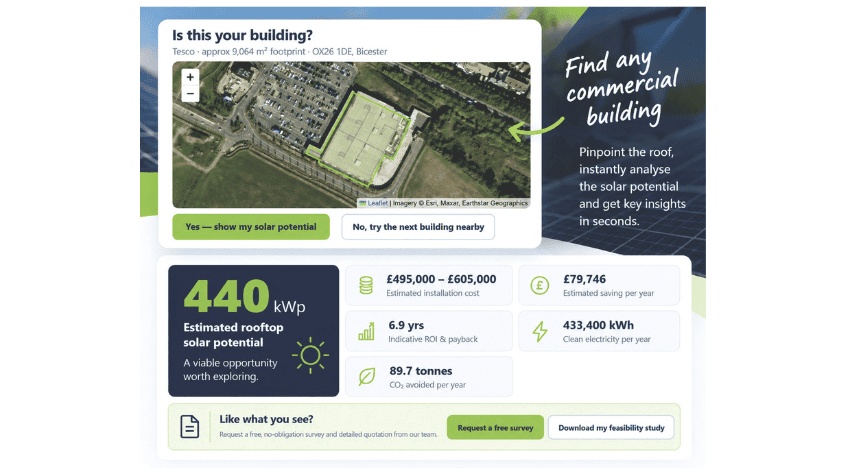
Elliot Jones, Managing Director, Tate Electrical Services Ltd and Founder of PVPossible.com, discusses how PVPossible.com helps identify commercial Solar PV opportunities across rooftops and car parks, providing early feasibility insights to help installers and property owners decide whether a site is worth pursuing. Its aim is to help the industry look beyond the roof and unlock more solar potential.
The idea behind PVPossible. com came about almost by accident. I had been invited to a large commercial site to look at an electrical tender and, while walking around with the customer, I noticed they had recently installed a substantial Solar PV system across several of the buildings.
The installation was well over 1MW and naturally caught my attention because of the type of work we carry out. Looking at it from an electrical contractor’s point of view, one of the things I noticed was how difficult parts of the system would be to access once the installation had been handed over.
I would estimate that around two-thirds of the panels were installed on roof areas where future access for inspection, cleaning, fault finding or maintenance would require significant access equipment.
That’s not to say there was anything wrong with the design. I knew nothing about the original brief, the customer’s requirements or the reasons behind the decisions that had been made. There could have been perfectly good reasons for using the roofs.
What interested me was what was sitting next to the buildings.
The site had a huge car park with more than 450-500 parking spaces, and I remember looking across it and wondering whether some of that space could have been utilised for Solar PV instead.
It got me thinking about something that I think we’re probably all guilty of to an extent. When we look at commercial Solar PV, we tend to look at the building and immediately start assessing the roof. In most cases that makes complete sense and, to be clear, the majority of the commercial systems we install ourselves are rooftop systems.
But are we always looking at the whole site?
When I got back to the office, I wanted to compare the two options. I wanted to know roughly what could have been achieved using the car park, how it would compare with the available roof space and whether there was potentially an argument for using both.
What became apparent quite quickly was how much work was involved just to answer what was, at that stage, a fairly simple question.
I wasn’t looking to produce a detailed design. There was no project to design. I simply wanted enough information to understand whether the alternative was worth investigating. That was really the starting point for PVPossible.
An early feasibility tool, not a design package
This distinction has remained important throughout the development of the platform.
There are already very good professional Solar PV design packages available, such as PV*SOL, and PVPossible isn’t intended to replace them. In fact, I see it sitting upstream of the process.
If an installer, consultant or property owner is looking at a commercial site for the first time, there are some fairly basic questions they need to answer before committing time and money to a full design.
Is there enough usable space? What sort of system size might be achievable? What could it potentially generate? Is there a large car park that should be considered as well as the roof? And, most importantly, is there enough of an opportunity to justify taking it any further? That is what I wanted the platform to help with.
If the answer is yes, that’s when the proper work begins. A site survey still needs to take place. The condition and suitability of the roof or ground needs to be established. The customer’s electrical demand and infrastructure need to be understood. Structural requirements, planning, DNO requirements and all the other site-specific issues need to be considered before moving into detailed design.
PVPossible is simply intended to provide useful information earlier in that process.
Car ports won’t be right for every site
There is also a commercial reality with solar car ports that can’t be ignored.
At the moment, installing panels on an existing suitable roof will often provide a better payback than constructing a solar car port. With a rooftop system, the structure is already there. With a car port, you’ve got the additional structure, foundations, groundworks and associated infrastructure to pay for before you even start considering the PV installation itself.
Those costs can make a significant difference to the payback and will inevitably rule out car ports on some projects.
But I do think the market is beginning to change.
We’re starting to see different car-port systems and construction methods coming onto the market, and I think we’ll see further innovation in this area over the next few years. As the products develop and more are installed, I’d expect some of those costs to come down.
There are also benefits that don’t necessarily show themselves if the decision is based purely on the shortest Solar PV payback.
You’re providing covered parking as well as generating electricity. You’ve got an obvious opportunity to incorporate BESS & EV charging. Depending on the system, future access for inspection and maintenance can potentially be much more straightforward than accessing panels spread across several difficult roof areas.
For certain sites, those additional benefits could be important.
How the idea developed
Initially, I was developing the concept purely because I thought it would be useful within my electrical contracting business Tate Electrical based in Hampshire.
I wanted to be able to look at a hospital, warehouse, school, supermarket or another commercial site and get some sensible early information without spending hours developing a proposal that might never go anywhere.
As I worked on it with my developer, we started looking at commercial roofs as well as car parks. That seemed the obvious thing to do because it meant we could assess the two areas alongside each other rather than treating them as completely separate opportunities.
It was at that point that we realised the same tool could potentially be useful to other people in the industry.
An installer could use it to carry out an initial assessment before deciding whether to invest more time in an opportunity. A consultant looking across an estate could use it to identify which sites might warrant further investigation. Equally, a property owner who knows very little about Solar PV could use it to get an initial understanding of what might be possible on their own building or car park, without having to approach multiple contractors for proposals before they even know whether there is a worthwhile opportunity. It gives them some useful information upfront, allowing them to have a more informed conversation with an installer when they’re ready to take the project further.
The other part of the problem is finding these opportunities in the first place.
Recent research suggests that more than 90% of suitable commercial roof space in the UK is still not being utilised for Solar PV. That is a huge amount of potential sitting largely untapped.
There must be thousands of commercial properties across the UK with large roofs and car parks where Solar PV has either never been properly considered, or perhaps was looked at several years ago when the technology, costs and commercial case were very different.
For me, that highlights another challenge for the industry. Before we can design and install these systems, we first need to identify where the opportunities are and give building owners enough information to start the conversation.
As PVPossible developed, we therefore started looking at how we could help installers identify potential sites and, where possible, identify the business or organisation associated with the property so that the opportunity could actually be brought to their attention.
For me, though, it is important that the platform stays in its lane.
It is an early feasibility and opportunity identification tool. It isn’t there to tell an installer how to design a system and it certainly isn’t there to replace the technical work and competence that are required once a project progresses. Its job is to help establish whether there is something worth designing in the first place.
Looking at the whole site
Going back to the site where the idea first came from, I still don’t know whether the car park would actually have been a better option. The rooftop installation may well have been the right solution once all the technical and commercial considerations were taken into account. But that’s really the point. I wanted an easier way to make that initial comparison before investing significant time developing both options.
As an industry, I think we’re going to have to become better at looking at sites as a whole, particularly as Solar PV, battery storage and EV charging become increasingly connected. Commercial rooftops will continue to provide a huge opportunity for Solar PV, but they’re not the only space available to us.
Sometimes there may be another opportunity sitting right next to the building. We just need to remember to look at it.


