By Cameron Beech, Head of Product Management & Training, Viessmann Climate Solutions UK.
For many homeowners, the journey to a low-carbon home begins with a single investment. It might be a heat pump, solar PV panels, charger for an electric vehicle (EV) or, increasingly, battery storage. Traditionally, these technologies have been purchased independently of each other, often with little consideration for how future additions will work together. However, that approach is beginning to change.
As electricity prices fluctuate, dynamic tariffs are becoming more widespread and households are looking for greater optimisation and control over their energy use, the focus is shifting from a piecemeal approach to creating smart energy ecosystems. Rather than simply generating or consuming electricity, homes are becoming capable of managing energy automatically, using the right technology at the right time to maximise efficiency, minimise running costs and reduce carbon emissions.
At the heart of this transformation is what could be described as the ‘golden triangle’ of home energy: heat pumps, solar PV and battery storage. Each technology delivers benefits in its own right, but when intelligently connected, their combined value is significantly greater than the sum of their individual parts.
Challenges
Until now, however, connecting them has not been that easy. Different manufacturers, incompatible controls and multiple smartphone apps have often resulted in appliances that operate independently rather than collaboratively.
Related to this is the issue of affordability. Few households are in a position to invest simultaneously in a heat pump, solar PV, mechanical ventilation and heat recovery (MVHR), battery storage and an electric vehicle charger. More commonly, these technologies are installed over several years as budgets allow.
This makes future-proofing those early investments challenging. A homeowner purchasing any one item today needs confidence that it will integrate seamlessly with others installed several years later, without the need to replace existing controls.
This is precisely the thinking behind the new monobloc air-to-water heat pump from Viessmann, and the One Base Intelligence platform that underpins it.
Intelligent answer
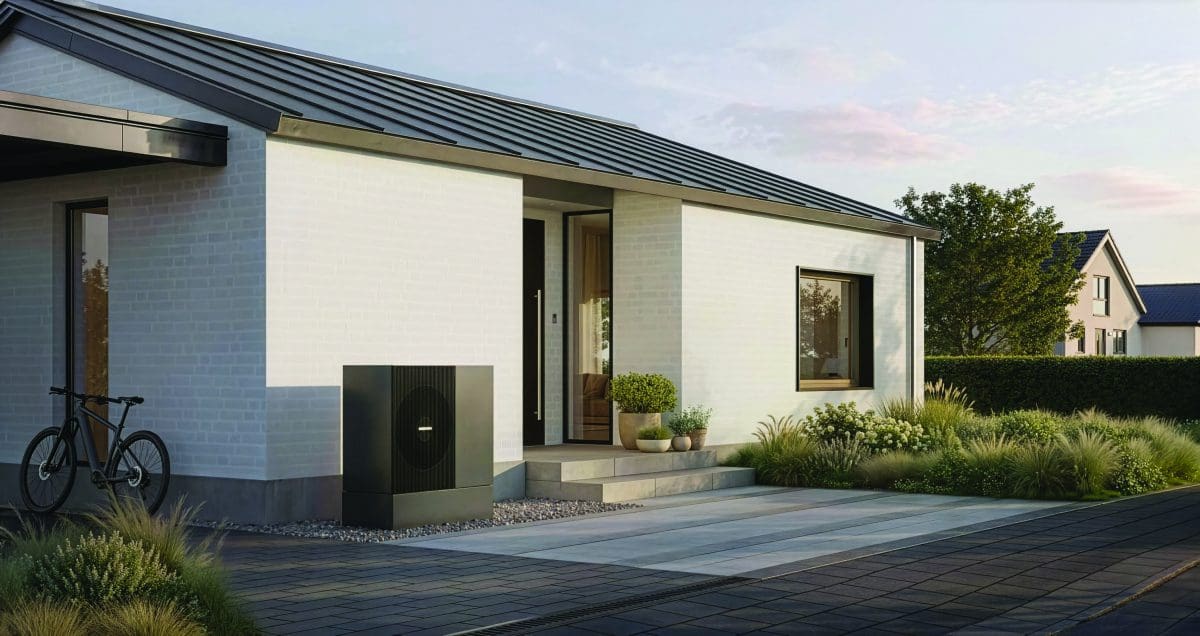
Launched as the first of a new generation of intelligent energy products, the Vitocal 200-A ie has been designed not simply as a heating appliance, but as the foundation of a complete home energy ecosystem. Whichever element a householder starts with, every component can become part of a single smart, autonomous system, growing alongside the household’s requirements without concerns over compatibility or duplicated controls. This allows customers to build their energy infrastructure progressively, making the transition to low carbon living far more achievable.
The real innovation lies in the software. Viessmann’s One Base Intelligence isa self learning platform that provides a unified operating logic for connected energy technologies.
Rather than managing multiple devices independently, One Base Intelligence continuously monitors and optimises energy flows across the entire home. All heating and energy devices can communicate through the same intelligent system, presented to the homeowner as one central control unit via the ViCare app.
This holistic approach removes much of the complexity traditionally associated with home energy management. Instead of the occupants manually deciding when to charge a battery or vehicle, heat the hot water cylinder or deploy self-generated electricity, the system continuously learns household behaviour and automatically adjusts operation to maximise efficiency and take advantage of cheaper energy prices.
For homeowners, the result is lower running costs and improved convenience. For installers, it removes many of the compatibility concerns that have historically complicated multi-technology installations.
Open by design
Another important feature of the new platform is its openness. Renewable technology is evolving rapidly, and few homeowners want to be locked into a single manufacturer. We have therefore designed One Base Intelligence to integrate not only with its own products but also with selected third-party technologies and controls.
Equally, the new Universal Controller can even be installed as a standalone controller, bringing any compatible heat pump, solar PV or air conditioning system into the ViCare platform. For installers, this creates opportunities not only in new installations but also in upgrading existing renewable systems with improved energy management.
Dynamic tariffs
As electricity suppliers introduce increasingly sophisticated time-of-use tariffs, the ability to use power when it’s cheapest is becoming almost as important as reducing the amount consumed.
The Universal Controller has been developed with this in mind. It allows the system to automatically optimise operation according to electricity pricing. Instead of homeowners having to monitor tariff changes or programme multiple devices individually, the system can intelligently coordinate the heat pump, battery storage and solar generation to maximise self-consumption and minimise imported electricity during expensive periods.
This intelligent optimisation is enhanced by over-the-air software updates, allowing new functions and improvements to be introduced throughout the system’s lifetime. Rather than becoming outdated, the platform continues to evolve alongside changing tariffs, technologies and energy markets.
Made for the UK market
While its digital capability attracts much of the attention, the new heat pump has also been developed to simplify installation. Designed specifically with input from UK renewable heating specialists, it reflects practical feedback gathered over several years, covering everything from pipework layouts and electrical connections to packaging and the way British homeowners use their airing cupboards.
The outdoor unit has also been designed with installers in mind. Models up to 12 kW use a single-fan configuration, with outputs from 4 to 12 kW covering around 70-80% of UK homes. Weighing from around 90 kg, the units remain relatively straightforward to transport and install, with every model fitting on a standard Euro pallet.
For larger properties, up to four heat pumps can be cascaded together to deliver maximum outputs of 48 kW using only one indoor unit and a single wall penetration. This reduces installation time while simplifying system design.
Golden Triangle
The golden triangle of heat pumps, solar PV and battery storage already offers compelling environmental and financial benefits. Intelligent software now unlocks even greater value by ensuring each technology works in harmony rather than isolation. For installers, this creates opportunities to build long-term customer relationships as systems evolve over time. For homeowners, it offers reassurance that investments made today will remain compatible with tomorrow’s technologies.
The new Vitocal 200-A ie represents more than the launch of another heat pump. It signals a move towards expandable, intelligent home energy systems where products can be added as budgets allow, software improves continuously, and renewable technologies operate as one coordinated whole. As the transition to low-carbon homes accelerates, that flexibility may prove just as valuable as the efficiency of the heat pump itself.
www.viessmann.co.uk