By Ian Little, UK Business Development Manager, Resideo.
The UK’s transition to lowcarbon heating is gathering pace. Driven by continued energy challenges, the replacement of ageing boiler systems and continued government support for low-carbon technologies, heat pumps are becoming seen as an increasingly important heating option.
For installers, this presents a significant opportunity to add value for customers. But while attention understandably focuses on installing heat pumps, an equally important conversation is emerging around how these systems are controlled. We’ve explored this topic in detail in our recent white paper Practical Approaches to Controlling Heat Pumps and pulled out some key elements in this article.
Homeowners are likely to judge their investment in a heat pump not simply on efficiency figures, but on comfort, ease of use and everyday performance. That makes heating controls an important consideration in heat pump system design.
The white paper notes that the UK market is still finding its footing, although uptake is gathering pace, with over 51,000 retrofit heat pump installations recorded by DESNZ in 2025 and over 60,000 MCS-certified heat pump installations recorded in the same year.
Across Europe, markets such as Germany and the Netherlands continue to demonstrate the growing appetite for renewable heating, with Germany installing around 345,000 heat pumps during 2025 and the Netherlands adding approximately 143,000 systems in the same year1.
As the UK market continues to mature, installers are expanding their skills to meet growing demand. City Plumbing research cited in the white paper found that, out of 500 UK installers surveyed, 58% were already trained and a further 34% planned to upskill in the following 12 months. This points to growing professional engagement with heat pump technology. However, installing the heat pump itself is only part of the equation.
To deliver systems that consistently meet customer expectations, installers also need a strong understanding of heating controls and the role they play in achieving comfort, efficiency, and long-term system performance.
Control strategy should no longer be viewed as an optional extra or a final commissioning task; it should be considered from the earliest stages of system design.
Homeowners increasingly expect heating systems that are intuitive to operate, responsive to changing lifestyles and capable of delivering consistent comfort while supporting efficient operation. Those expectations place heating controls firmly at the centre of the customer experience.
Heat pump and comfort control
For installers, this creates an opportunity to add value and help to differentiate their services. There is no single control strategy that suits every property, with the most appropriate approach depending on factors such as property type, hydraulic design and homeowner expectations.
An effective heat pump installation begins with understanding the distinct roles played by the heat pump controller and the comfort controls.
The heat pump manufacturer’s controller should remain responsible for managing how heat is generated. Functions such as flow temperature management, weather compensation and compressor modulation are fundamental to maintaining efficient, stable operation. These sophisticated controls are specifically designed to optimise the performance of the heat pump itself.
Comfort controls perform a different but important role.
Rather than determining how heat is produced, they manage how heat is used throughout the home. This includes scheduling, temperature adjustment and, increasingly, room-by-room zoning.
Keeping these responsibilities clearly separated can support a more predictable and easier-to-manage system. The heat pump controller focuses on heat generation, while dedicated comfort controls can allow homeowners to tailor heating around daily routines and preferences.
Where the system is correctly sized, designed and configured, this approach can support predictable commissioning and maintenance, while helping to deliver consistent comfort over the lifetime of the installation.
Demand-led comfort control can also help to support efficient energy use. Instead of heating an entire property to the same temperature throughout the day, zoning can allow heat to be directed where and when it is needed. However, as the white paper makes clear, any zoning strategy must preserve minimum flow, follow manufacturer requirements and be supported by appropriate hydraulic design.
Comfort control options
Installers now have access to a range of comfort control solutions that can complement modern heat pump installations, depending on the connected system, configuration and manufacturer requirements.
Resideo’s portfolio of heating controls is designed to support this separation between heat generation and comfort management, where compatible with the heat pump, interface type and system design. Whether a homeowner requires straightforward time and temperature scheduling or more advanced multi-zone control, installers can select solutions that suit both the property and the customer’s expectations.
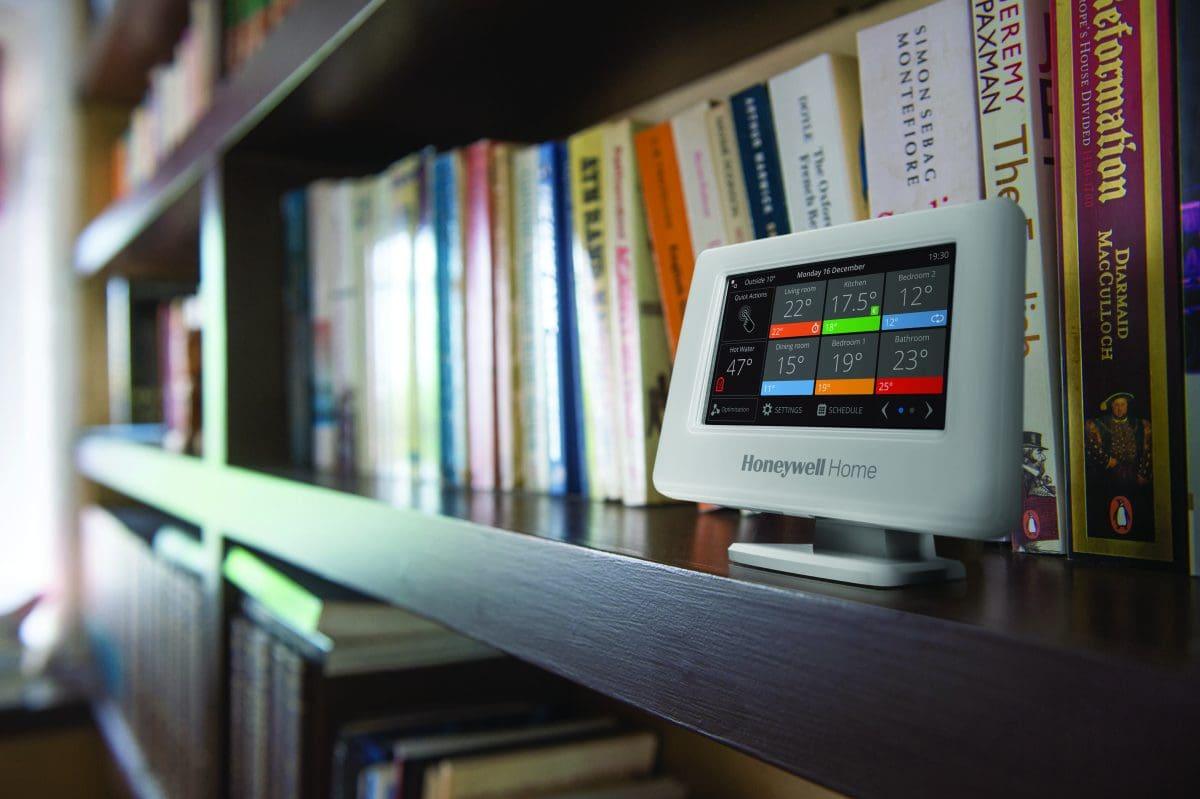
For some installations, a simple programmable thermostat such as the T3 or T3R may provide suitable time and temperature control, subject to compatibility with the connected system and manufacturer requirements. Larger or more complex properties may benefit from advanced zoned solutions such as evo home, where room-by-room control is required and the hydraulic design supports minimum flow.
Where underfloor heating form’s part or all of the heating system, the HCC100 multi-zone controller can provide a purpose designed solution for managing multiple wired and wireless thermostats, where the system is designed and configured to maintain appropriate operating conditions.
Understanding where each of these solutions fits within different system designs can help installers provide informed recommendations rather than simply supplying a thermostat. As heat pump installations become more common, this product knowledge may become an increasingly valuable differentiator.
Train to gain
Developing this expertise requires ongoing learning. While many installers are investing in heat pump qualifications, expanding knowledge of heating controls should form part of the same professional development journey.
A thorough understanding of control strategy enables installers to have more informed conversations with customers, specify systems more accurately and deliver installations that achieve both technical performance and customer satisfaction.
Resideo Academy has been developed to support installers in building these skills. Through a combination of instructor-led courses, online learning modules and the Resideo Academy app, installers can access flexible training designed to fit around busy working schedules.
This can help professionals build confidence from specification through commissioning and customer handover.
As heat pump adoption continues to accelerate, installers who understand the complete heating system, not just the heat pump itself, will be better placed to support customers. Specialist comfort controls are not a replacement for the manufacturer’s controller; they perform a complementary function focused on comfort, scheduling and zoning.
Homeowners will evaluate their new heating system in the same way they have always judged central heating: Does it keep the home comfortable? Is it easy to use? Does it perform reliably day after day?
For installers, answering “yes” to those questions depends on the control strategy as well as the heat pump itself. By considering comfort controls from the earliest stages of system design, installers can support more predictable installations, more confident customers and fewer avoidable callbacks.
Download full report: www.resideo.com/gb/en/ solutions/home-comfort/heat-pumpwhite-paper
Source
1. https://ehpa.org/news-and-resources/press-releases/heatpump-sales-testify-to-government-action/